
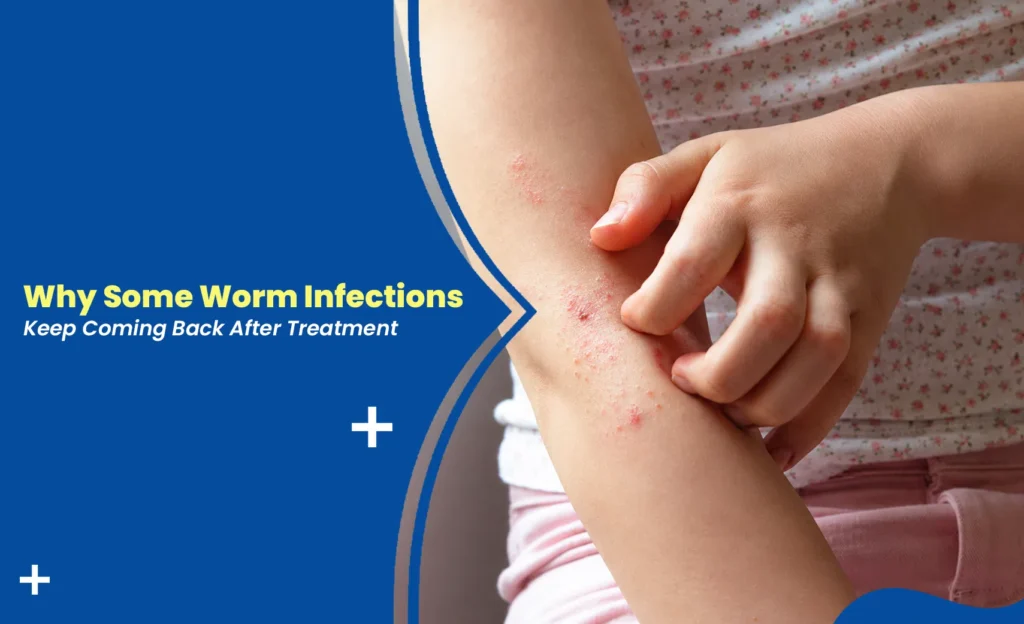
Your pets take the medicine, follow the directions, and assume your pets’ problem is solved. So why do worm infections keep coming back weeks or months later? It is one of the maddening patterns of dealing with parasitic disease. As it turns out, there is good science behind it. Worm reinfection after treatment is not an indication that treatment has failed completely. It is usually a combination of biology, environment, and behavior that works against a single round of medication.
This blog explains exactly why that happens, what the research says about how often it occurs, and what actually helps break the cycle.
The Uncomfortable Truth: Reinfection Is the Rule, Not the Exception
The common thing in endemic areas (where a specific disease, plant, or animal is naturally found) is worm infections keep coming back after treatment. A large systematic review and meta-analysis found that the prevalence of roundworm (Ascaris lumbricoides) had returned to 26% of pre-treatment levels within 3 months. There is a 68% chance to return within 6 months and a remarkable 94% within 12 months for reinfection. In essence, reinfection rates in many communities a year out are nearly the same as they appeared before treatment was ever administered.
Why do worms come back after deworming? One round of medication will clear the worms in your pet’s body at that moment but does nothing to change the environment that your pet will continue to encounter.
Recurring Worm Infection Causes: It’s Rarely Just One Thing
- Environment-Related Egg Contamination
Research shows parasite eggs can survive in soil for ten to twelve months in tropical climates, depending on climatic conditions. Separate studies of contaminated produce found eggs of common soil-transmitted helminths surviving on crops for four to twelve months. That means that the soil in your backyard, your garden, or your local farmland can silently harbor infectious eggs for the better part of a year after the original source of contamination is gone. Thus, worm infections keep coming back.
- Gaps in Drug Efficacy
Not every treatment gets rid of all the worms. Research into reinfection patterns has shown that a single dose of albendazole, the most widely used drug in mass drug administration programs, does not always clear intestinal helminths fully, especially Trichuris trichiura infections. Some “reinfections” are actually persistent infections that never got fully cleared in the first place.
- “Predisposition” to Infection
Animals are consistently reinfected with soil-transmitted helminths even after successfully clearing their infections with treatment. This is probably due to a combination of behavioral, occupational, and environmental exposure factors that do not change after treatment ends.
Worm Infection Returning After Medication: What the Numbers Actually Show
Following anthelmintic therapy against Ancylostoma ceylanicum, the chances of reinfection in adult dogs decreased by 77%; that does not mean to say that reinfection did not occur. Of the 127 canine patients with a history of endoparasites, 68.5% had no parasites on the subsequent fecal exam, 22.0% had 1 parasite, and 9.4% had 2 or more parasites. The age of the animal appears to influence the likelihood of re-infection, as per this figure. The percentage dropped to 18.4% in animals between 1 and 4 years of age before increasing again to 31.5% in animals over 10 years old.
Can Worms Come Back After One Treatment? Yes!!! Why??
Can worm infections keep coming back after just one treatment? It’s a fair question, and the honest answer is yes, often, and it’s part of how these infections work. One treatment deals with the worms living in your pet’s body that day. It’s doing nothing for:
- Killing eggs that have been laid in nearby soil, water or produce
- Changing current exposure to contaminated environments
- Ensuring that all worm species present (especially whipworm) are 100% gone
- Avoiding catching a new infection from another animal in the household or community
This is precisely why mass deworming programs are set up as repeated campaigns, rather than one-off events. Public health researchers are aware that anthelmintic drugs kill helminths inside a host but do not prevent reinfection in between rounds of treatment.
Why Does Deworming Not Work Sometimes? Looking at the Weak Points
In some cases, the reason deworming doesn’t work is due to a mix of drug-specific and situational limitations. Thus, worm infections keep coming back. Some parasites are just tougher to get rid of with a single dose. For example, whipworm is the classic case, with cure rates consistently lower than roundworm in many studies. Dosing regimens also matter: studies comparing single-dose with multi-dose treatment have shown several times that extended courses achieve meaningfully higher cure rates than a single dose alone, particularly for hookworm and whipworm infections.
Healthcare providers can use other anthelmintic drugs when the standard single-dose therapy is not working well. Fenbendazole 150 mg is a member of the benzimidazole class of anthelmintics (along with other commonly used worming drugs) and works by binding to tubulin, interfering with the parasite’s energy metabolism. The medication, dosing schedule, and duration of treatment should be decided by a healthcare provider based on the specific parasite identified and individual patient factors, as with any dewormer.
Worm Eggs Surviving After Treatment: The Environmental Reservoir Problem
A real threat even after successful treatment has cleared the worms from an animal’s body is worm eggs surviving after treatment in its surrounding environment. Soil samples from various sites have demonstrated high levels of persistent contamination, and worm infections keep coming back. A study of farm soils detected 41.33% of samples positive for soil-transmitted helminth eggs, while another study found contamination in 44.48% of soil samples tested, involving several worm species.
How to Prevent Worm Reinfection: What Actually Works
- Wherever possible, improve access to sanitation, as poor sanitation is one of the strongest drivers of ongoing environmental contamination.
- Wash and cook produce properly, especially vegetables grown in soil that may be contaminated or irrigated with untreated wastewater.
- When one animal is diagnosed, treat the whole household at the same time, particularly for pinworm, which is easily spread from animal to animal.
- Do not assume that one round of medication has completely cleared the infection; follow up with repeat testing after treatment.
- For harder-to-clear infections such as whipworm, a repeat or combination treatment course under the guidance of a healthcare provider can be useful, as single-dose therapy alone is often not enough.
The Bottom Line
The blog on “worm infections keep coming back” after treatment is not a mysterious failure; it is a well-documented phenomenon that is driven by resilient eggs in the environment, continued exposure, and the biological limitations of single-dose therapy against certain parasite species. Fenbendazole 150 mg is a broad-spectrum benzimidazole anthelmintic (anti-parasitic medicine). Most often found as chewable pills or granules, the 150 mg dose type is especially suitable for medium-sized canines and small cattle. The medicine mostly acts by blocking the energy metabolism of parasites, therefore causing their final death and host body ejection.
FAQ
1. Why do you get recurrent worm infections even after treatment?
The reason for reinfection is that the treatment only clears worms that are already in your pet’s body but does not kill eggs that are already in the environment, in soil, in produce, or in your household. The most frequent cause of infection recurrence is continued exposure to the contaminated sources.
2. How long do worm eggs live in the soil?
Worm eggs can live in the soil for many months depending on the climate; some studies have shown survival up to ten to twelve months in tropical conditions. Therefore, contaminated environments can be a risk for re-infection long after the original infection has been treated.
3. Can worms come back after one treatment of medicine?
Yes, this is common, especially for whipworm infections, which always have lower cure rates with single-dose treatment than roundworm or hookworm. Repeated or combination dosing as directed by a healthcare provider often produces better long-term results.
4. How do your pets get reinfected from contaminated surfaces?
Reinfections are transmitted via eggs on hands, clothing, bedding, and household surfaces. These eggs are easily spread by casual contact, so it is generally necessary to treat entire households and to wash bedding and clothes thoroughly to break the cycle of reinfection between family members.
5. How do your pets get out of the cycle of getting reinfected permanently?
The best approach is a combination of regular handwashing, wearing footwear in high-risk areas, treating all household members at the same time if needed, washing produce carefully, and returning to the healthcare provider for repeat tests or a modified treatment plan if reinfection persists.