
The smell of damp earth is usually a comfort, isn’t it? It’s that petrichor scent that signals a garden finally getting a drink. But there’s a different kind of smell that comes after a flood-a heavy, metallic, and slightly sour scent that lingers in the air long after the water has retreated from the floorboards. It’s the smell of a landscape that has been turned inside out.
I remember walking through a small coastal town in the UK after a particularly nasty storm surge a few years back. The locals weren’t just worried about their carpets or their cars; there was this palpable, quiet anxiety about what the water had brought with it. And they were right to be worried. When we talk about climate change and extreme weather, we often focus on the immediate “splashes”-the dramatic rescues or the crumbled infrastructure. We rarely talk about the invisible hitchhikers that stay behind.
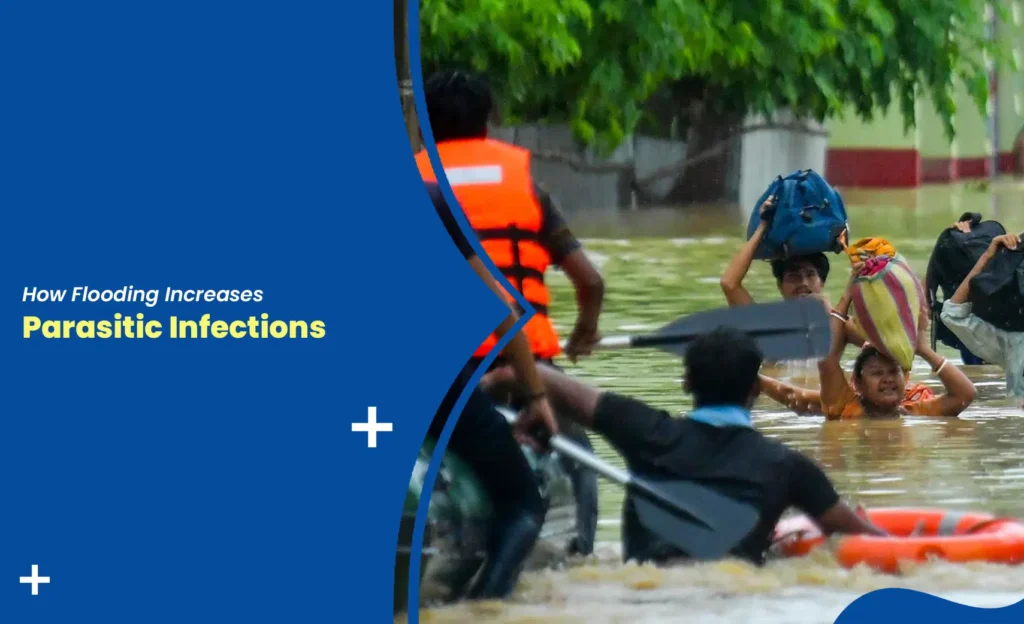
Flooding is essentially a massive, chaotic mixing bowl. It takes everything-sewage systems, agricultural runoff, pristine river water, and chemical waste-and shakes it all up before depositing it into our backyards. For parasites, this isn’t a disaster; it’s a grand opening.
The Great Migration of the Microscopic
It’s easy to think of parasitic infections as something that happens “over there,” in tropical climates or places with less developed infrastructure. But water doesn’t care about borders. When a river in the US Midwest breaks its banks or a flash flood hits a London suburb, the biological rules change instantly.
Think of a flood as a high-speed transit system for pathogens. Normally, something like Cryptosporidium or Giardia might be contained in a specific pond or a section of livestock pasture. But once the water rises, those barriers vanish. These organisms are incredibly hardy; they’re often encased in cysts that act like tiny suits of armor, allowing them to survive the turbulent, debris-filled journey into human habitations.
Have you ever wondered why health officials are so adamant about not wading through floodwater? It’s not just the risk of a rusty nail or a hidden manhole. It’s the fact that you’re essentially swimming in a soup of every intestinal parasite from every animal within a ten-mile radius. It’s a sobering thought when you see kids playing in the “new lake” in the local park after a storm.
The Lingering Guest
The real trouble begins when the water leaves. As the puddles dry up, they leave behind a fine silt. This isn’t just dirt. It’s a concentrated layer of whatever was in the water. In many cases, especially in regions where sanitation might have been compromised, this can lead to a spike in intestinal issues.
During my time covering public health shifts, I’ve seen how quickly a community can be sidelined by a sudden outbreak of “stomach flu” that turns out to be something much more persistent. When someone presents with a stubborn, parasitic infection after a flood event, clinicians often look toward targeted treatments. For instance, in many international contexts, a doctor might prescribe Aldol 400mg to deal with various systemic worm infections that thrive in compromised environments. It’s one of those “workhorse” medications that has been around for ages, often used because it’s effective against a broad range of these unwelcome guests.
But why does it feel like these infections are becoming more common? It’s a bit of a perfect storm. We have aging sewage systems in many Western cities that simply weren’t designed to handle the “100-year floods” that now seem to happen every five years. When the pipes back up, they don’t just go into the street; they back up into basements and crawl spaces-the very places where we store our lives.
The Soil Connection
We often overlook the soil. After a flood, the ground stays saturated for a long time. This creates a humid, anaerobic environment that is a paradise for certain soil-transmitted helminths. If you’re a gardener-and I’ll admit, my own attempts at growing kale are usually a disaster-you know how much you touch the earth.
After a flood, that earth is different. The parasites that were washed onto the land can persist in the soil for weeks or even months. It’s a strange, lingering legacy. You think the disaster is over because the sun is out and the debris is cleared, but the biological risk is still under your fingernails.
It’s a bit like a bad houseguest who leaves their muddy boots on your white rug and then hides under the bed. You think they’ve left, but you keep finding traces of them. In these scenarios, maintaining high hygiene standards is the only real defense. But sometimes, despite our best efforts, the parasites win the first round. This is where medical intervention becomes necessary. The use of Aldol 400mg is a common sight in global health clinics for a reason; it’s a straightforward way to clear out the “invaders” so the body can actually start the process of recovery.
The Psychological Toll of the Invisible
There’s a specific kind of exhaustion that comes with flood recovery. It’s the “mucking out” phase. I’ve spoken to families who have spent weeks scrubbing every surface with bleach, terrified that they haven’t done enough. And honestly, can you blame them? When you’re dealing with something you can’t see, the paranoia is a natural response.
Is it possible that we’re underestimating the scale of the problem? Probably. Many parasitic infections don’t send you to the ER immediately. They’re slow burners. They cause fatigue, mild bloating, or “just not feeling right.” In the chaos of rebuilding a home, who doesn’t feel fatigued? It’s easy to dismiss the symptoms as stress when, in reality, your body might be fighting a literal internal battle.
I remember a conversation with a specialist who noted that the uptick in cases often follows the weather patterns with a lag of about three to four weeks. Just as people are moving back into their homes, the symptoms start to peak. It’s a cruel timing. At that point, the primary goal is getting back to a baseline of health. Sometimes that involves a course of Aldol 400mg, depending on the specific parasite identified, to ensure that the infection doesn’t become a chronic burden on the immune system.
Changing the Narrative
We need to stop seeing floods as purely “water” events and start seeing them as “biological” events. The way we design our cities and even our homes needs to account for this. It’s not just about higher flood walls; it’s about better filtration, more resilient sewage management, and a public that actually understands the risks of “dirty” water.
Have you noticed how we talk about “natural” disasters as if they are separate from us? But our choices-where we build, how we manage our waste-directly dictate how “natural” the outcome is. When a storm hits, the parasites are just doing what they’ve evolved to do for millions of years: find a host. They don’t have a plan; they just have an opportunity.
In areas where flooding is a chronic issue, health education becomes as important as sandbags. Knowing when to seek a prescription for Aldol 400mg or how to properly decontaminate a kitchen can be the difference between a minor setback and a long-term health crisis. It’s about empowerment through a bit of uncomfortable knowledge.
The Reality on the Ground
If you find yourself in a flood-prone area, or if you’ve recently dealt with rising waters, keep an eye on the “small” things. Are you more tired than usual? Is your digestion a bit “off”? It’s worth a chat with a professional. We live in an era where we have the tools to fix these things. Whether it’s a specific regimen involving Aldol 400mg or just a targeted course of probiotics to rebuild your gut flora, you don’t have to just “tough it out.”
I sometimes think about that UK town and wonder how they’re doing now. The houses are probably repainted, and the gardens likely look lush again. But I bet if you asked the people who lived through it, they still look at a heavy rainstorm a little differently than they used to. They know that the water carries stories-and sometimes, those stories have teeth.
We’re moving into a future where these events aren’t “once in a lifetime” anymore. They’re our new seasonal reality. And while that sounds a bit grim, it’s also a chance to get smarter. We can’t stop the rain, but we can certainly get better at dealing with the microscopic fallout.
It’s a bit of a strange world, isn’t it? One day you’re worrying about your mortgage, and the next you’re learning about the lifecycle of a liver fluke because your basement flooded. But that’s the reality of living on a changing planet. We’re all learning on the fly.
When you look at the medical kits sent to disaster zones, you’ll almost always find anti-parasitic medications. The presence of Aldol 400mg in those kits is a testament to how universal this problem is. It’s a global struggle against a very small, very persistent enemy.
Final Reflections
So, what’s the takeaway? Maybe it’s just that we should respect the water a bit more. Not just its power to move cars or knock down trees, but its power to transport life-even the kind of life we’d rather not meet.
If you’re cleaning up after a storm, wear the gloves. Use the bleach. Don’t let the kids play in the puddles, no matter how much they beg. And if you start feeling like something is “hitching a ride,” don’t wait. Sometimes, a quick intervention with something like Aldol 400mg is all it takes to get your life back on track.
It’s a long road to recovery after a flood. The physical rebuilding is exhausting enough; you don’t need a parasitic infection making it harder. We’re all just trying to keep our heads above water-literally and figuratively. Let’s make sure we’re not bringing the worst of the storm inside with us.
I’ll keep my kale in raised beds for now, I think. And maybe, just maybe, I’ll keep a closer eye on the weather app. Not because I’m afraid of a little rain, but because I’ve seen what happens when the river decides to come for a visit. It’s never just a visit; it’s a total takeover.
Keep your boots by the door and your hand sanitizer closer. We’re in this together, navigating a world that’s getting a lot wetter and a lot more complicated. But as long as we keep sharing these stories-and the solutions-we’ll be alright.
FAQs
1. I feel fine, but I waded through some floodwater to save my cat. Should I be worried about parasites?
Look, we’ve all been there-in the heat of the moment, you aren’t thinking about microscopic cysts; you’re thinking about your pet. If you don’t have any cuts and you showered immediately with obsessive amounts of soap, you’re likely okay. However, parasites are patient. If you start feeling “off” or deal with sudden, unexplained bloating a few weeks from now, don’t just chalk it up to post-flood stress. It’s worth mentioning the exposure to your doctor. In many clinical settings, a professional might suggest a broad-spectrum approach like Aldol 400mg if they suspect you’ve picked up an uninvited guest from that water.
2. Is it true that I can get a parasitic infection just from breathing near drying flood mud?
It sounds like a horror movie plot, doesn’t it? But unfortunately, there’s a grain of truth to it. As flood silt dries out, it turns into a very fine dust. If that mud was heavily contaminated with certain parasite eggs or larvae, they can technically become airborne if you’re sweeping or leaf-blowing the dried residue. This is why you see health journalists and experts constantly nagging people to wear N95 masks during the cleanup. It’s not just about mold; it’s about not inhaling the literal ghost of the flood.
3. My kids played in the “big puddle” in the street after the storm. What symptoms should I watch for?
We’ve all seen it-the neighborhood kids treating a flooded street like a theme park. The problem is that street water is basically a cocktail of oil, sewage, and animal waste. Keep an eye out for the “classic” red flags: sudden diarrhea, stomach cramps, or a weirdly persistent cough (some parasites actually migrate through the lungs). If they start losing their appetite or seem unusually lethargic, get them checked out. Depending on the diagnosis, a pediatrician might look at treatments similar to how adults use Aldol 400mg to clear out the system and get them back to their usual high-energy selves.
4. Can I just “wait out” a parasitic infection, or do I always need medication?
I get the temptation to just drink some ginger tea and hope for the best, but parasites aren’t like a cold-they don’t usually just “pack up and leave.” They are evolutionarily designed to stay as long as possible. Left untreated, some can cause long-term nutritional deficiencies or even organ damage. If a stool test comes back positive, your doctor will likely put you on a targeted regimen. Medications like Aldol 400mg are frequently used because they effectively “starve” the parasites, making it impossible for them to keep hitching a ride in your gut.
5. I’ve scrubbed my house with bleach, but I’m still paranoid. How do I know my home is actually safe?
That “post-flood paranoia” is a very real, very exhausting mental weight. If you’ve stripped the drywall, replaced the carpets, and bleached the hard surfaces, you’ve done the heavy lifting. The biggest lingering risk is usually the soil right outside your door or hidden damp spots in the crawlspace. My best advice? Keep a “no shoes in the house” rule strictly enforced for a few months. It’s a simple, low-tech way to make sure you aren’t tracking contaminated dirt back into your clean sanctuary. If you’ve done the work, try to breathe-you’ve reclaimed your space.